Food Labels

Food Regulation in South Africa
orange-164985_1280

But I didn’t know: A brief guide to Food Regulation in South Africa

When manufacturers think of “Food regulations”, generally the first things that will pop to mind are the Labelling regulations (R146/2010). Furthermore, if they are asked who governs the food regulations in South Africa, I would imagine the first response you would get is the Department of Health. Although not incorrect, the Department of Health is only one of the bodies tasked with the regulation of food in South Africa. Likewise, the Labelling regulations are only a few of a plethora of regulations directed at the management of food safety and the rights and wellbeing of the consumer. Our aim with this article is to try and provide you with a brief overview of the regulatory landscape of food within South Africa.

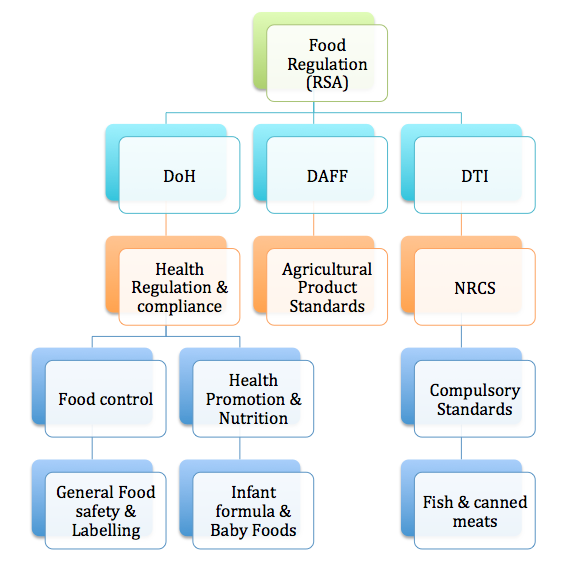
There are three main government departments tasked with the management of Food Safety and Quality, namely the Department of Health (DoH), Department of Agriculture, Forestry and Fisheries (DAFF), and the Department of Trade and Industry (DTI) – See hierarchy on lefthand panel. These departments have very specific mandates.

The DoH is tasked with the management of food hygiene (certifying manufacturers – Certificate of Acceptability), developing food safety & quality standards, and managing the country’s food labelling, nutrition and fortification requirements.

Under the DoH, Directorate: Food control is responsible for the administration and enforcement of the DoH food regulation, and to provide consumers with the power to make informed food choices without being misguided.

Similarly, the Chief Directorate: Health Promotion and Nutrition (previously, Directorate of Nutrition) is tasked with the development of a national nutrition programme and the administration of the baby foods and infant formula regulations.

DAFF is responsible for regulating agricultural products including traditional processed products such as jams, vinegars, pickles, honey and canned vegetables, through to dairy products, ice- creams, meat and poultry. It is interesting that the scope of DAFF’s administration does not only cover agronomy, agricultural practices and fresh produce, but extends also to agricultural product standards relating to labelling (grading and marking), import and export. DAFF regulations are promulgated at National level, but enforcement takes place at Provincial level. Thus always ensure that any agricultural products are passed by your local DAFF inspector before being placed on the shelf.

The other regulatory authority, the DTI regulates all canned meats, canned and frozen fish and seafood. Under the DTI, these products are regulated by the National Regulator for Compulsory Specifications (NRCS) through technical regulations known as compulsory specifications. All facilities that produce these products must abide by the strict requirements of these compulsory specifications (VC documents).

As you can see the food regulatory environment within South Africa is understandably quite complex, as different authorities regulate different aspects of labelling, food safety, facility design and product standards. For this reason it is imperative to ensure that all aspects around a product have been addressed before going to market. In many organisations this expertise is available in-house, however in other cases or with highly technical foods it can be well worthwhile to engage the services of a food safety and food labelling consultant.

Article by: David Scott

Claims

Food for thought

Food for Thought – How useful are Nutrition labels to the average South African?

With escalating rates of lifestyle-related health issues globally, it has never been more important that consumers are aware of the factors which are under their control when they make food choices. Understanding and correctly interpreting food labels can enable consumers to make informed decisions about the foods they choose to purchase and provide to their families.

In the 2011 study Consumers’ knowledge of food label information: an exploratory investigation in Potchefstroom, South Africa, some valuable insights were gained despite the limited scope.

The study was limited to a group of 299 participants, of which the largest component was Afrikaans-speaking females with a tertiary education and no children. However, 4% and 38% of respondents had below grade 12 or up to grade 12 levels of education respectively.

While information such as best before dates, storage instructions and identifying symbols such as Halaal or Heart Foundation endorsements were easily and accurately identified by the vast majority of respondents, only 53% of respondents were able to calculate how many serving sizes were included in a product. Since many food labels give nutritional information ‘per serving’ – this indicates a clear problem in correct application of the information, even if the values themselves are largely understood, and the participants are well educated. In addition, manufacturers are required to include nutritional values per 100g – however whether this will be of benefit to a consumer making an in-store decision under a time constraint is debatable.

While many consumers may be aware that is it recommended for them to cut back on saturated fat, only 3% of respondents could correctly identify a food as being low in saturated fat.

Under the current labelling regulations (R146/2010) the amount of saturated fat ‘per serving’ and ‘per 100 g’ are mandatory where nutritional information or claims are provided.

Even more importantly, as long as a food manufacturer does not make any nutritional claims about their product – it is not compulsory for them to publish these details at all. And this is not entirely negative – smaller manufacturers without the funds to have their product analysed by an accredited laboratory every 3 years should certainly not be prevented from entering the marketplace in the first place; and they will still be required to provide a list of ingredients, additives, allergens, storage information, etc.

But does reading and understanding food labels actually lead to improved choices?

According to Food and nutrition labelling: the past, present and the way forward (Koen et al., 2016), the short answer is yes. People who make use of food labels were found to be more likely to make informed food choices in practice – with their diets reflecting a reduced fat, cholesterol, sodium, and overall energy intake, and increased consumption of fibre, iron and vitamin C.

In light of this since the publication of the latest regulations relating to the labelling and advertising of foodstuffs, or R146/2010, we have certainly made some progress towards food labelling practices which are easier for the average consumer to understand, however there is still significant room for improvement.

Looking at the largest South African study to date conducted after the implementation of the new regulations, conducted by Bosman et al. with 1997 respondents across four ethnic groups – some general areas of interest were uncovered:

• Most consumers are able to locate the nutritional information on packaging, however some expressed uncertainty in their understanding of the information provided.

• Consumers who did not read labels on a frequent basis indicated lack of interest, habitual purchasing, price concerns and time constraints as the main reasons.

Furthermore, in 2008, 41% of women and 21% of men in South Africa were classified as obese, with 32% of females and 35% of males with high blood pressure, which are considered to be diseases of lifestyle. (WHO, 2014). Between 2010 and 2011, the Department of Health enacted laws governing Trans- Fat and saturated fat in foods and their labelling. Similarly, Sodium reduction laws, currently being revised, were published in 2013, for enforcement between 2016 and 2019.

In essence, many consumers still have difficulty putting their knowledge into action when making purchasing decisions, even with the current labelling systems. While there may be scope to improve the current R146 regulations and make them more accessible to the average consumer – a certain degree of accountability must be taken by individuals as well. Fine tuning the regulations and bringing them in line with global best practices is a goal we certainly need to strive towards, however the education of the public in making food choices is clearly just as vital.

Engagement invitation: What are your thoughts? Do you find nutritional labels hard to decipher? Let us know in the comments section below.

Article by: Catherine Robinson

References

1. van der Merwe D, Bosman M, Ellis S, de Beer H, Mielmann A. Consumers’ knowledge of food label information: an exploratory investigation in Potchefstroom, South Africa. Public Health Nutr 2012: 16(3) 403-408.
2. Koen N, Blaauw R, Wentzel-Viljoen E. Food and nutrition labelling: the past, present and the way forward. S Afr J Clin Nutr 2016: 29(1) 13-21.
3. World Health Organization. Noncommunicable Diseases (NCD). Country Profiles, 2014.

Contaminants

A Weed is just a misplaced plant

bee-549221_1920The Foodstuffs, Cosmetics and disinfectants Act No. 54 of 1972 [1] requires that food marketed to humans is not injurious to health. This is a “catch all” statement – so where no specific regulation exists, in court the onus would be on the producer to ensure the food is safe for human consumption.

Codex defines a contaminant as “Any substance not intentionally added to food or feed for food producing animals, which is present in such food or feed as a result of the production (including operations carried out in crop husbandry, animal husbandry and veterinary medicine), manufacture, processing, preparation, treatment, packing, packaging, transport or holding of such food or feed, or as a result of environmental contamination.” Interestingly they exclude physical contamination such as insect fragments and rodent hair. (CODEX STAN 193-1995)

Currently there are many South African regulations that deal with contaminants including: heavy metals (R500 of 2004), pesticides (R246 of 2005) colourants (R1008 of 1999), hydrocarbons (R230 of 1977) and toxins; even allergens in the labelling regulations (R146 of 2010) could be classed under contaminants.

Rather than expecting a complete absence of a contaminant, regulations often state a permissible level for a specific food group, or all foodstuffs. So it is vital to understand that if a limit exists in a certain product group, this does not mean that other groups are not regulated. Thus, other groups should not contain the contaminant. For example preservatives are permitted in certain food categories, but considered contaminants in similar categories.

This was certainly true for the Pimaricin in export wine case (2009). Pimaricin, commonly used to preserve fruit juices and fruit concentrate was found in some export wines; it was present due to the addition of grape concentrate, occasionally used in the winemaking process. Although allowed in South African wines it is prohibited in some countries.

In some cases regulations do not exist for contaminants, either as the need for regulation has not yet arisen, or because no amount of contamination should be allowed. Two examples that illustrate this point are Sudan red and melamine. When these scares hit in 2005 and 2008 respectively, industry started looking for regulations specifying limits for these compounds.

Sudan red is a colourant used in various industries mainly oil and gas, and should never be in contact with food. As such, there was, and still is, no need for it to be specifically legislated. No amount of Sudan red would be safe for consumption.

For melamine, no legislation existed at the time, but now R1054 of 2009 is in place. Apart from adulteration and food fraud, melamine may also come into contact with food through use of certain containers. Prior to this regulation the onus would have been on the producer to prove that a small amount is firstly safe in the product and secondly present purely due to unavoidable circumstances.

Whether added or unintentional, if it is harmful or not permitted, much like ‘a weed is just a misplaced plant’, these substances if present in foodstuffs are contaminants.

Article by: Norah Hayes

Footnote:
1. Regulations are listed under number and year of first print and should include all subsequent amendments.